

LoRaWAN sensors, from the field to the cloud
What LoRaWAN is, why it suits a large site, how a gateway and sensors fit together, and what we run on it today.
The problem with a large site
The places you most want a reading are often the ones with no power and no network. A cold room at the far end of the yard, a pump house, a laydown area, a trailer that moves. Running a cable to each one is expensive. Sending someone round with a clipboard gives you one reading a day, and none at night.
What LoRaWAN is
LoRaWAN is an open radio standard for small, battery-powered devices that send short messages over a long distance. These are properties of the standard, not measurements of ours:
- Long range, low power. It trades speed for distance. A sensor sends a few bytes at a time and sleeps in between, which is how a battery-powered sensor can run for a long time without a visit.
- No SIM card in each sensor. It uses radio bands that need no licence. Sensors talk to a gateway on your site, and only the gateway needs an internet connection.
- Each device has its own key. A device joins the network with a key of its own, and its messages are encrypted over the radio.
- It is not for everything. Messages are small and infrequent. It suits a temperature every few minutes. It does not carry video or fast-changing signals.
How far a sensor reaches depends on the ground, the buildings in between and how high the gateway's antenna sits. We have not published a range figure, because we have not yet measured one we would stand behind.
How a gateway and sensors fit together
The gateway is the one box on site that listens. Sensors and trackers send their readings to it by radio, and it passes them on to Powoflow over its own internet connection. Each device is set up for your account, and its readings arrive on the asset it belongs to, in the right units.
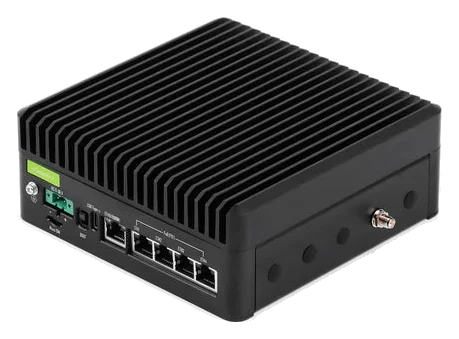
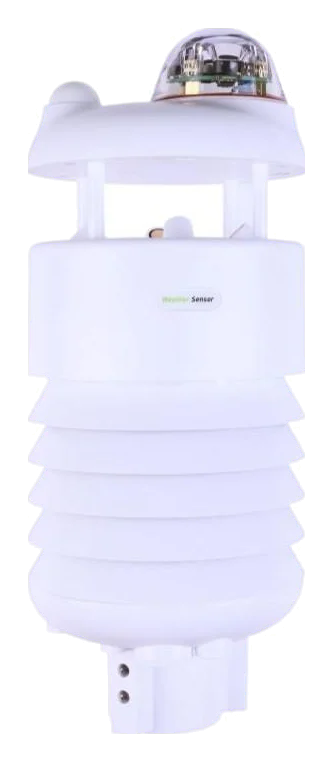
Our site gateway is Powoflow Sense Mesa, an industrial gateway in a weatherproof enclosure. It can also read equipment wired to it. That is how the weather station connects: by cable to the gateway, not over LoRaWAN.

What we run today
- Trackers: live. A tag for people and small assets with an SOS button, and a rugged asset tracker with a tamper alarm. Both report position and battery over LoRaWAN. See asset tracking.
- Weather station: live. Wired to the gateway on our own test site. Wind, rain, temperature, humidity, pressure and light, with the history kept.
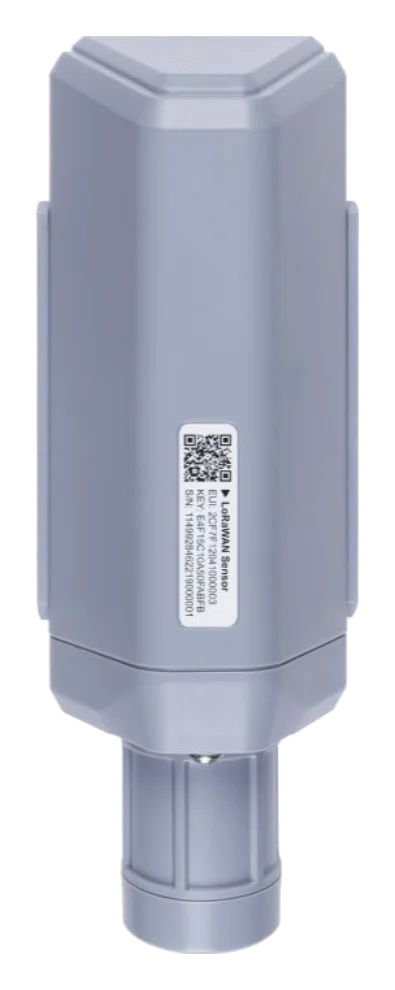
- Air temperature and humidity sensors: in validation. They report on our test system and are still being validated. We can supply them on request.
Alarms, and the sensor that goes quiet
A threshold alarm is a limit you set on a reading: too hot, too cold, too windy. A silent-sensor alarm covers the other failure. A sensor with a flat battery, or one that has been knocked off its bracket, sends nothing, and a chart with no new points is easy to miss. So when a sensor stops reporting, Powoflow raises an alarm for that too, and someone can go and look.
Alarms show in Powoflow in your browser. With the mobile app, an alarm also arrives as a notification on your phone.
What it does not do yet
- Soil, light, carbon dioxide, pH, leak and door sensors are not validated. We have decoders for some of them and have not yet run a unit.
- Sensor kits have no published prices. They are supplied on request and priced when you ask.
- Alarms do not reach you by email or text message yet.
- There is no automatic alarm when a whole site goes down. Set a silent-sensor alarm on one sensor at that site.
- We have no measured range, battery life or sensors-per-gateway figure to give you yet. When we have run the test, we will publish it here.
Tell us what you need to measure
We will say plainly what we can measure today and what is still in validation.